Wednesday, September 26, 2018

New England: Old and New


New England: Blending Old with New

On our recent trip to New England, it was both a return to 'home' and a visit to a new place. I spent every summer in Connecticut and Maine when I was a child. My best friend had a cabin in Maine, and my first visit came when I was 9 years old. My parents had a cabin in Connecticut that I went to every summer until well into my 40's. That being said, those cabins were in the western parts of their respective states. This trip took us along the coast; a new territory for me to explore.

As it is when one returns home, Larry and I were on the lookout for the familiar, and it came out in comments such as; "that house looks like Connecticut", or "yep, that's something you'll only see in New England". But our trip wasn't about 'going home'. It was to see a new side to the familiar.

Colonial New England can be found throughout. The houses that were built 200 years ago and are still lived in today, aren't museum pieces, but they are a testament to the respect we have for our history. However, take a ride through coastal towns and those old houses, and the accompanying historic signs remind you, This is where America began!


The sign above is just up the street from this old house located in Castine, Maine; one of the oldest towns in New England.

Visit Philadelphia or Boston and you will be introduced to Revolutionary history. But visit the coast and you will be walking the paths first trod by those hearty and intrepid colonists who braved the ocean in little ships. (The Mayflower was only 110 feet long. By comparison, today's Royal Clipper Sailing Ship--a small luxury sailing cruise ship--is 442 feet long.)

"This lot bounded by Middle or King St. and LeBaron Alley was once owned by Dr. Samuel Fuller of the Mayflower and was given by his wife and son to the First Church for the use of the minister."

Most of the wooden houses built 400 years ago in Plymouth are gone, but markers fill visitors in on the story of Plymouth, or Plimouth, as it is written in some places. Plimouth is the old English version used by Governor William Bradford in his early journals.


Though never huge, Plymouth Rock is smaller than it once was, because people have chipped away at it. The historic rock is now protected in this monument built above it. A park ranger answers questions and explains how the Pilgrims landed here instead of in New York, after going off course. Their trip took them twice as long as expected, and winter was getting close, so the Pilgrims lived on the ship through the winter. The boats, used to carry men to shore for hunting and exploring, tied up to the rock and used it as a landmark.
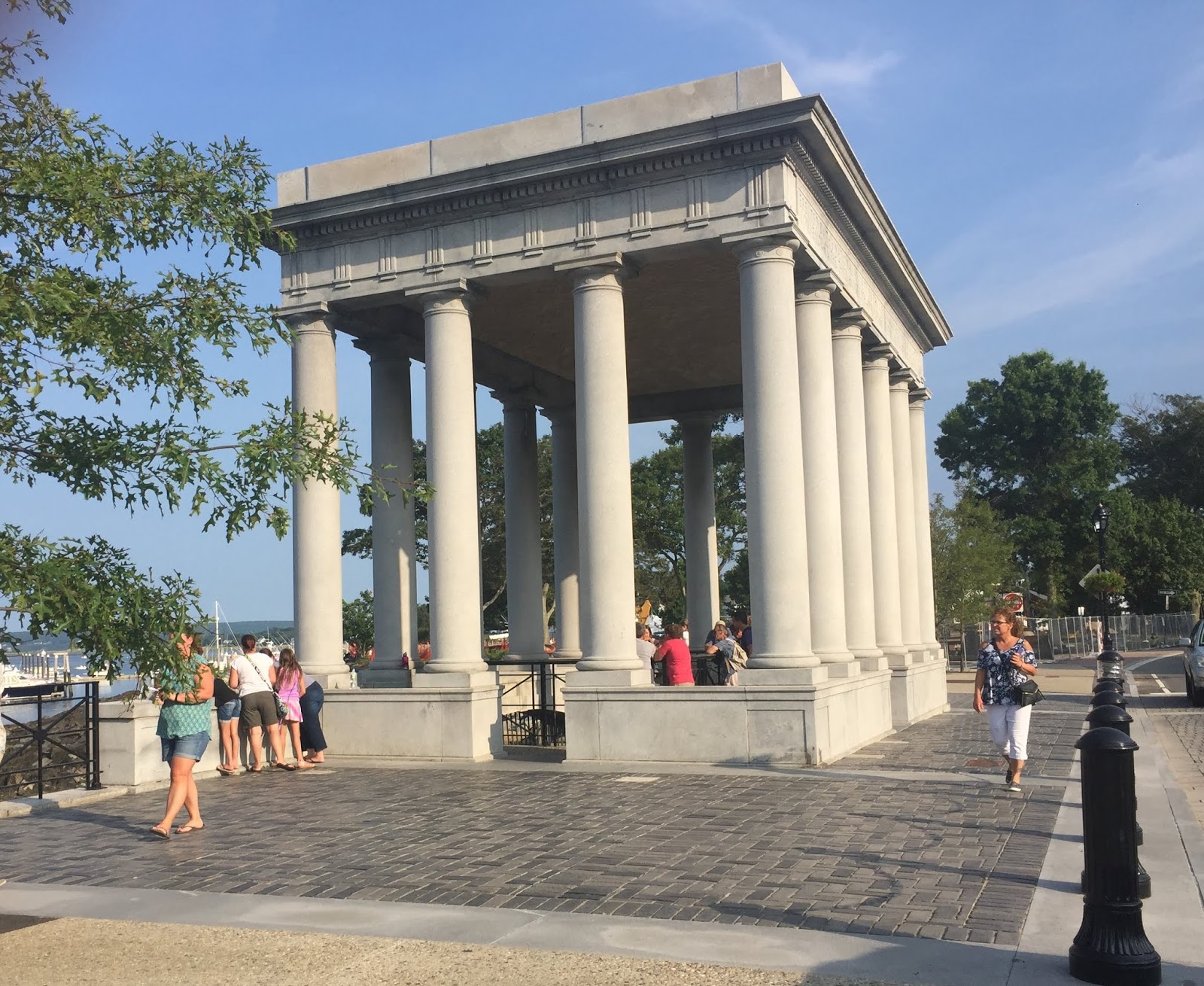
The Monument protecting Plymouth Rock

Historic towns are not the only interesting places to visit in New England. When we were in Burlington, Vermont, we had the pleasure of going downtown to the renewed and updated Church Street district, just blocks from the pier on Lake Champlain. Church Street has been turned into a pedestrian mall, with wonderful shops and great restaurants in a delightful atmosphere.


A beautiful old church appropriately anchors one end of the Church Street Open-Air Mall.
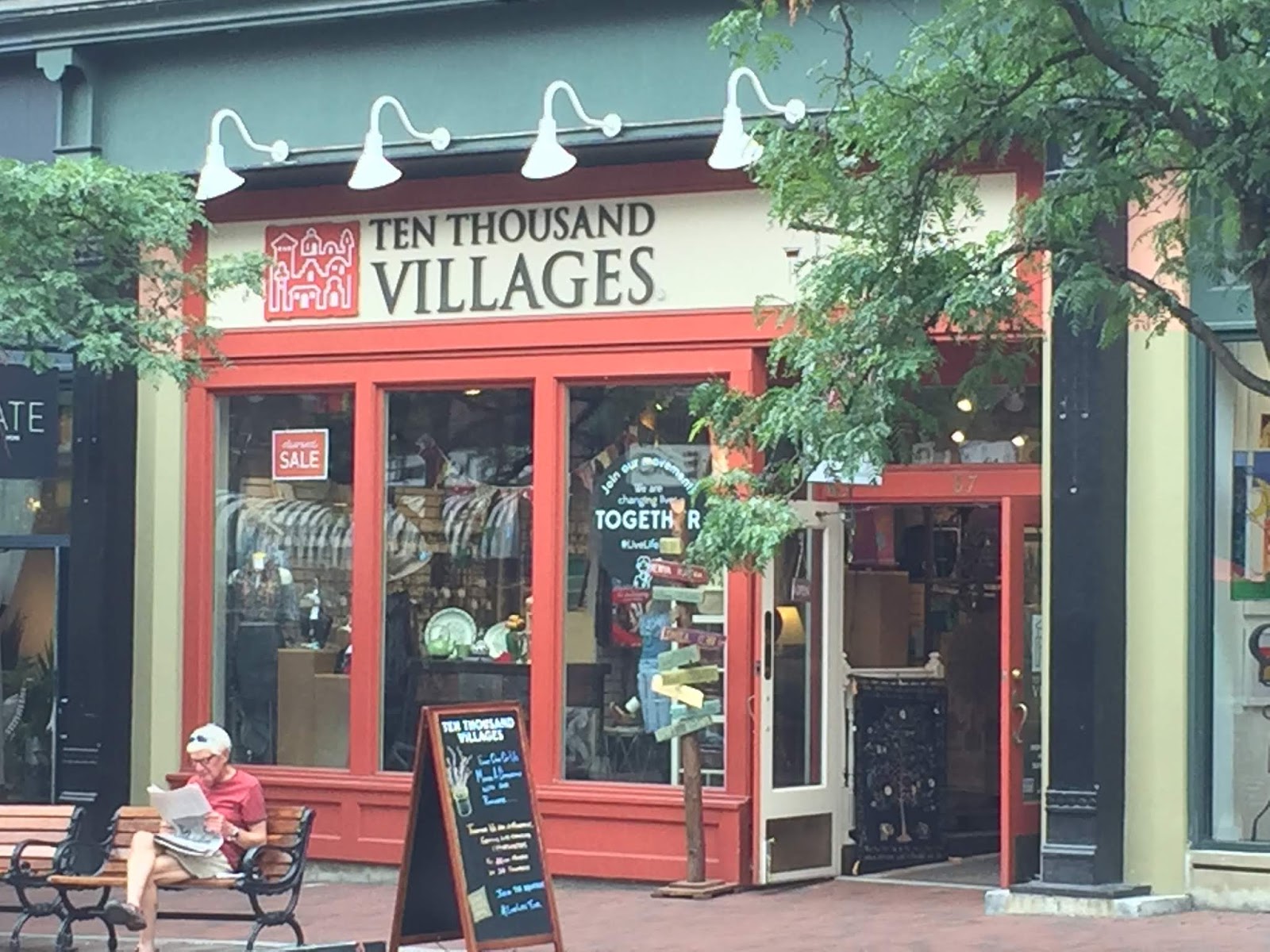
You won't find big name chain stores along this mall, but there were lots of interesting local shops such as this Fair Trade Store, Ten Thousand Villages, a non-profit store that markets hand crafted products made by artisans in developing countries. A Fair Trade Store sells only items made or grown in other countries where the workers are guaranteed a fair wage, and often some sort of savings plan so that they can grow use their profits to grow their business.


Outdoor cafes, interesting artwork and sculptures dotted the sidewalks. Larry discovered a chair lift bench just waiting to give his feet a rest.

Not all towns have been as able to reinvent themselves as Burlington did. For some, when the economy changed, it left the city behind. One such place was Whitehall, NY, located at the southern end of Lake Champlain, on the Champlain Canal. Whitehall was built on quarries, mining and shipping. When the ships became too big for the canals, and the rock mines were no longer in demand, the old town was left behind.

The Visitor's Center houses a very nice museum sharing the town's history.


In 1775, Benedict Arnold was a colonist and a ship builder. Over the winter he built 8 ships with the goal of preventing the British from gaining control of shipping on Lake Champlain.


A diorama showed Skenesborough, later renamed Whitehall, in its earliest days. This section shows the eight ships under construction. Arnold supervised construction of the ships and later commanded the small fleet. They lost the battle, but caused enough damage to British ships that when the British came back the next year, we were ready. Whitehall is considered the Birthplace of the American Navy.


Interesting Fact.: There is a document in the Library of Congress that declares Whitehall as the Birthplace of the U. S. Navy. However, Whitehall is not alone in making this claim. There are at least 5 places that believe they are the birthplace!

The museum also houses the remains of the first USS Ticonderoga, a wooden steamship built in Vermont, that fought in the War of  1812 on Lake Champlain.
 USS Ticonderoga: The remains of the original ship is mostly just the keel, the bottom boards that framed the hull. Below is a model of the original ship. Five Naval ships have been named USS Ticonderoga since this first one.

One of our favorite "old" spots was the working Mystic Seaport in Mystic, Connecticut. This place is both a replica of an old seaport town, and a working shipyard.


The shipyard builds or restores old style wooden sailing ships. While we were there, the Mayflower II had been brought in from its port in Plymouth, Massachusetts, to be restored. Wooden ships rot. The original ships may have only lasted 8-10 years. Mystic seaport is dedicated to using as many tools and methods as shipbuilders would have used 400 years ago.


Whaling Ships were common in early colonial times. Whales provided fuel for oil lamps among many other things. Long boats were hung from the side of whaling ships (like lifeboats today). Early whalers would lower the long boats when tracking a whale. After harpooning a whale it would take off, pulling the boat behind it. Nantucket whalers referred to this ride as the Nantucket Sleighride. Other whalers picked up the term.

Walking through the village, we were treated to demonstrations. Here the whalers are demonstrating the techniques used to catch whales and bring them to the ship.


Mystic Seaport is a step back in time, but just down the coast on the Thames River is the town of Groton, home of the Submarine Force Museum, and the USS Nautilus, the Navy's first Nuclear submarine.


Learning about a sailors life aboard a ship is always fascinating, but submarines take it to a whole different level. It's amazing how well they function in such close, tight quarters.


Sleeping Quarters for 10!
Officers had it better!

Logging and ship building, may have been industry that helped build New England, but our trip took us to some newer businesses that have found their place. Waterbury, Vermont is home to Ben and Jerry's Ice Cream, Cabot Cheese, as well as Cold Hollow Apple Cider donuts. One thread ran through them. All of these companies had a sense of responsibility to the community, from a co-op of farmers (Cabot Cheese) to environmental responsibility.


It was hard finding a place to jump in at the Cabot Cheese Tasting table! And of course, we came out with some new flavors of cheese.
Ben and Jerry's was a fun tour with some Chunky Monkey at the end. Their Action Station booth outside fills visitors in on current political and environmental projects they are involved in. Climate change is a big focus.

The Cold Hollow Apple Cider Mill with fresh baked donuts smelled heavenly! But seeing how they press the apples was worth the stop by itself.

Mashed apples are placed in layers on these press boards. 15 boards are stacked, and raised into the press, squeezing the juice out.

Behind the mill they have converted a former corn field to a "sun field" that powers their cider mill.
The solar field behind Cold Hollow Cider Mill

My final two photos epitomize New England past and present.
Gold Brook Covered Bridge
Covered bridges dot the countryside and the tourist maps, especially in Vermont. A view into the past, most are roadside stops, or can be viewed from bridges. The Gold Brook Covered Bridge, near Waterbury, Vermont, is one of the few still in use.

Solar Fields, or sun fields as one place dubbed them, have sprung up throughout the region. Many are small and power local businesses. But we spied them in power plants, and in fields like this one, which was one of the largest we saw. A view into tomorrow.

New England: Where the past blends with the future.

Friday, August 24, 2018

A Lobster Day in Maine

Maine and Lobster. Those two words are practically joined at the hip. Even the sign says so.

While we were in Maine, lobsters were part of our itinerary. The weather was good. The rain had taken a break and given the sun its place in the sky. And we headed for the water.

The Rugosa is a Lobster Boat out of Kennebunkport that takes landlubbers along while they haul in the daily catch. We also had a drive-by look at President George H.W. Bush's little place on the water! Well, it's actually not all that little. But I'll get to that later.

The Rugosa has a two person crew. Phil, the captain, cruised the waters, locating his traps and bringing them aboard, while Jesse, the naturalist, told us about molting and mating, big and little claws, why females prefer having wider hips.... in short we learned about lobsters and lobstering.

For instance...

Have you ever wondered how those big claws get a rubber band around them? Turns out, they aren't born that way. It also turns out it's so easy, even a kid can do it as long as they have that handy banding tool (and someone to hold the wiggling creature).

And if you've ever wondered, the closed claw doesn't just protect humans, but other lobsters. They are feisty critters who will grab ahold of anything! Even each other!

Speaking of claws that grab, lobsters have two distinct claws; the crusher and the seizer, which pretty much tells you the main job of each one. The crusher is the biggest one.

Lobsters live on the bottom of the ocean. They don't swim around. They eat mainly what is found there, like crabs, sea urchins, snails, plants and other fish.

Once a Commercial lobster fishermen gets a license, he or she can work up to 800 lobster pots or traps. However, getting a license in the state of Maine isn't easy. There are a limited number of licenses and they can be passed from generation to generation. There is currently a 15-year waiting list!

And then there is the buoy. Each lobster fisherman registers the color scheme that identifies his traps. Most use a 2 color scheme although you can do more. Which makes me wonder, how many color combinations can you come up with before you run out of schemes? Perhaps that explains why our boat had 4 colors on their buoy!

Our boat was licensed as an educational boat, and had only 20 traps. We visited 5 traps on our tour. That left 15 traps for the other 3 daily tours. We had lobsters in each trap, but we were told that one trap is baited with 2 lobsters so there will always be a catch. The other 4 traps were up to chance.
Maine residents can fish up to 5 traps, after passing a test.

As I said, lobsters are feisty and they tend to lose parts of their body. Luckily they can regenerate legs, claw or antennae. Two of the lobsters we caught that day were growing new claws. One had a really tiny new claw coming in, but this lobster's new claw was coming along.

After the lobster fisherman snags his trap he lays the buoy on the gunnel of the boat so other fishermen know he is checking his traps, and loops the rope over a pulley, and pulls..... and pulls.

If he's fishing in Maine, he inspects the lobsters in the trap, keeping those whose bodies are between 3" and 5". The smaller ones are thrown back to get bigger. The larger ones have proved to be of hardy stock and are thrown back so they can mate and produce strong offspring.
Jesse is holding a sizing tool against the lobster to measure it. This one is just 3". The whole tool in her hand is 5".

This is the rule in Maine, but not all states. If you ever get a big lobster, it came from other New England waters, not Maine. The ones kept are put in a live well, a tank with water, until they get to shore.

He also flips the lobster over to make sure she isn't carrying eggs on her abdomen. This lobster is not carrying any eggs. If she was her underside would be covered in tiny black bubbles or dots--the eggs. A female with eggs is always returned to the ocean. Female lobsters have wider tails than males to carry anywhere from 5,000 to 100,000 eggs. That sounds like a lot, but between hatching and growing up, less than .02% may survive, only to land on my dinner table. Makes me really glad I'm not a lobster.

But this guy's a keeper! And so is the lobster.


Two of the Rugosa's traps just happened to be by President Bush's (#41) place.

We stopped offshore to learn some more about lobsters, and to wave at the Bush's in case anyone was looking.

When the flagpole is flying the U.S., Maine, and Texas flags it's a sign the family is there. We were also told that while we were watching them, they were watching, and listening, to us. After that, everyone had only very nice things to say!

Then it was time to return to the dock. Jesse let the kids take turns tossing our catch back into the water. As a licensed educational lobster boat, the Rugosa isn't allowed to keep its catch.
When we got back to the dock, the Secret Service Boat was coming through the inlet.

Was it something we said??

Our tour was fascinating and we learned a lot, but once back at the pier, it was time for dinner. We headed down the coast to Kittery, where we could enjoy dinner on the docks. Truth be told, in coastal Maine any place with a tank of water and two-burner hotplate advertised lobster for dinner so we didn't have to go very far. However, as my husband puts it, my family has a TRADITION.

Members of my family have eaten at Chauncey Creek for the last 50 years, and I wasn't about to snub my nose at TRADITION.

Here the lobster is delivered fresh to the dock each day.


Chauncey Creek offers chicken tenders for those who want them, but that's not what they're known for.

After all that time learning about lobsters, you would think we would have a new respect for the tasty critters, and we would be looking forward to a hamburger for dinner.

Nope. We just had a healthy respect for the gourmet dinner before us, and the people who caught it.